2026 Best Lead Rubber Sheet for Radiation Shielding
Choosing the 2026 best lead rubber sheet for radiation shielding requires more than comparing thickness or price. The right material depends on the radiation source, energy range, exposure conditions, and the design of the protected space. A sheet intended for a diagnostic imaging room may not suit another application. Details matter.
Lead rubber sheet combines lead-based shielding with a flexible rubber layer, making it useful where rigid barriers are difficult to fit. It may be considered for protective curtains, equipment covers, or lined panels, depending on the product’s tested specifications. Flexibility helps with installation, but it does not guarantee adequate protection. That distinction is easy to miss.
This guide explains what to check when evaluating products in 2026, including lead equivalence, sheet dimensions, construction, surface condition, and available test documentation. Ask suppliers for clear, product-specific data rather than relying on broad claims or a familiar brand name. A qualified radiation safety professional can help assess whether a proposed product suits the intended use and installation.
There is no universal “best” sheet. Performance depends on the complete shielding design, including seams, overlaps, mounting, and areas around openings. Even a well-made product can leave gaps if installed carelessly. I would also treat unusually simple comparisons with caution; real projects rarely fit neatly into a table. The aim here is to support informed selection, not replace a site-specific assessment.
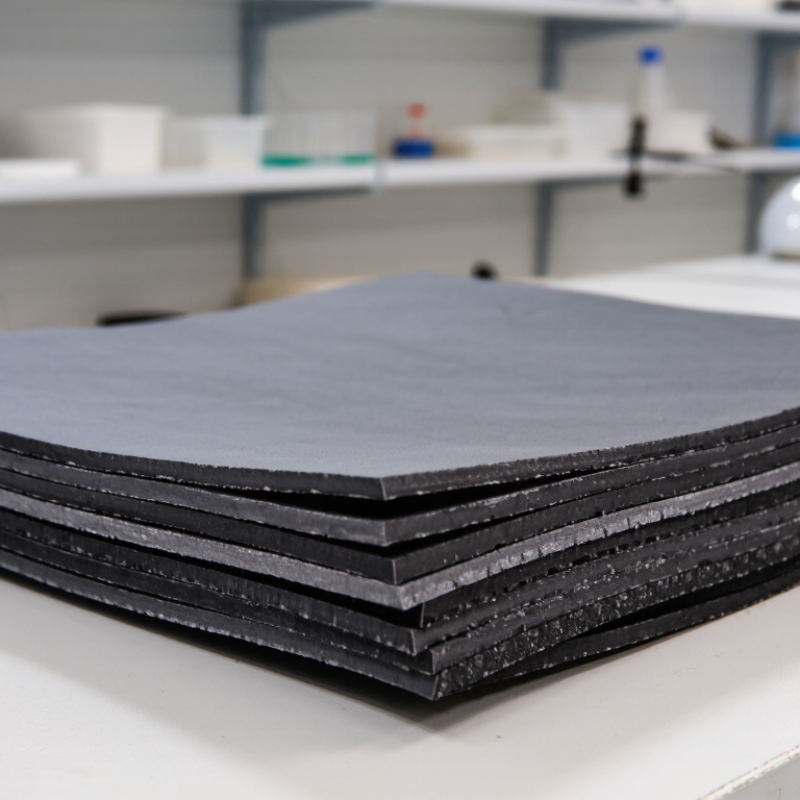
What Lead Rubber Sheet Is and How It Shields Radiation
Lead rubber sheet is a flexible composite: finely dispersed lead compounds or lead particles are embedded in an elastomer matrix. The rubber helps the sheet bend around corners, doors, and equipment housings. Lead does the shielding work. Its high atomic number, 82, makes it effective at attenuating many diagnostic X-ray photons through photoelectric absorption and scattering. Not magic. Shielding depends on photon energy, lead content, and sheet thickness.
The NIST XCOM Photon Cross Sections Database reports a mass attenuation coefficient for elemental lead of about 5.55 cm²/g at 100 keV. This is a material reference, not a performance rating for a rubber sheet; the composite’s actual attenuation depends on its lead loading and construction. A seam, a stretched edge, or a poorly covered cable opening can also create a weaker path. Small details matter.
In practice, compare sheets using verified lead-equivalent thickness at the relevant beam energies, then confirm suitability through a qualified radiation-protection assessment. NIST data show why one thickness cannot be assumed to work for every spectrum. A sheet tested for one X-ray range may perform differently at another. And installation can be imperfect: wrinkles and gaps are easy to overlook, so inspect the finished barrier, not just the product label.
Radiation Types and the Role of Sheet Thickness
Radiation type determines whether lead-rubber sheet is suitable and how thick it should be. X-rays and gamma rays are penetrating photons; lead reduces their intensity by absorbing and scattering them. Higher photon energy generally requires more material for the same reduction. There is no universal thickness. A 1 mm sheet may help in one low-energy inspection setup, yet be inadequate around a higher-energy source. The actual requirement depends on the energy spectrum, workload, distance, geometry, and permitted dose. Small details matter.
Beta particles behave differently. A lead surface can generate bremsstrahlung when struck by energetic electrons, so a low-atomic-number layer, such as suitable plastic, may be placed toward the source before lead. Neutrons are not effectively controlled by lead sheet alone; they usually need purpose-designed hydrogen-rich or other specialized shielding.
Check the radiation field, not just the equipment label. For an installation, a qualified radiation-protection professional should calculate thickness and verify it with appropriate measurements. Seams, overlaps, cutouts, and worn spots can leave gaps. Easy to overlook.
Recheck shielding after moving a source or changing its operating settings; that step is often skipped.
Materials, Construction, and Performance Standards
For 2026, the best lead rubber sheet depends on verified shielding performance, not thickness alone. Its lead particles are dispersed through an elastomer, then formed into flexible sheets. Ask for lead content, sheet thickness, batch traceability, and test results. Uneven filler distribution can create weak spots, especially near cut edges or seams.
Photon energy matters. NIST’s XCOM database reports lead mass attenuation coefficients of about 5.55 cm²/g at 100 keV and 0.071 cm²/g at 1 MeV. These figures describe elemental lead, not a finished rubber sheet; composite performance also depends on lead loading and construction. Require attenuation or lead-equivalence results at stated X-ray beam qualities. IEC 61331-1 provides methods for determining attenuation properties, while ASTM B749 covers lead sheet products, not the complete rubber composite. A standard name alone proves little. That distinction is easy to overlook.
Tips: Check the test report’s beam energy, measurement setup, and stated lead equivalence. Inspect sample edges for gaps or cracking. Ask how seams and penetrations are handled. NCRP Report No. 147 supports shielding design for medical X-ray facilities, but site-specific workload and occupancy still matter. Don’t assume one sheet suits every room; even a careful specification can miss a poorly fitted joint.
How to Choose Lead Rubber Sheet for Different Applications
2026 Best Lead Rubber Sheet for Radiation Shielding
How to Choose Lead Rubber Sheet for Different Applications
Choose lead rubber sheet by the radiation source, workload, and installation—not by thickness alone. In diagnostic X-ray rooms, confirm the required lead equivalence at the operating kilovoltage. A rating at one energy should not be assumed to perform identically at another. NCRP Report No. 147 sets shielding design goals of 0.1 mGy per week for controlled areas and 0.02 mGy per week for uncontrolled areas. These are planning goals, not ready-made sheet specifications; a qualified shielding assessment should determine the actual barrier design.
For mobile screens or protective curtains, flexibility and repeated handling matter. Check the sheet’s tested lead equivalence, dimensions, edge finish, and support method. A heavy panel can sag if its frame is undersized. In industrial radiography, beam energy and exposure conditions may differ greatly from routine medical imaging, so do not transfer a medical-room specification without review. Real installations are rarely that tidy.
Inspect seams, overlaps, and cut-outs carefully. A sheet can appear intact while a poorly joined edge leaves a weaker point. Ask for test documentation that identifies the measurement method and energy range, then verify that the installed assembly matches the design. Fit matters. A useful specification also states how the material will be cleaned, stored, and inspected over time. Those details are easy to overlook, but they affect practical performance.
Installation, Inspection, and Safe Handling Practices
Installation begins with the shielding plan, not the roll of lead sheet. Confirm the specified thickness, coverage, and supporting structure with a qualified radiation safety professional. Lead is heavy. Check that walls or frames can carry its weight before fixing it in place. Keep seams overlapped as specified, and pay close attention to corners, door frames, and service openings. Small gaps matter. Use suitable fasteners and cover exposed edges so the sheet stays secure and cannot be easily damaged. Avoid sanding or uncontrolled cutting, which can create hazardous dust or debris.
Inspect the work under good lighting before the area returns to service. Look for tears, loose fasteners, lifted seams, and openings around cables or pipes. A neat surface can still conceal a gap, so appearance alone is not enough. Have a qualified person verify shielding performance with appropriate, calibrated survey equipment and document the readings. Repeat checks after repairs, building changes, or equipment moves. During handling, wear work gloves, keep food and drink away, and wash hands after contact. If a sheet is damaged, stop work and seek qualified guidance rather than improvising a patch. It is easy to rush this step; that is exactly when small defects get missed.