
Buying Melamine Faced Plywood can look simple in a showroom. Smooth surfaces, neat edges, and attractive colors often create instant confidence. Yet a polished panel can hide weak bonding, uneven cores, or poor moisture resistance. I have seen buyers focus on appearance, then discover chipped edges during cutting. That mistake is easy to make.
This guide presents seven practical tips for choosing panels with greater confidence. It examines surface quality, plywood construction, thickness accuracy, emissions documentation, supplier consistency, and intended use. A kitchen cabinet, office shelf, and bathroom vanity face different demands. The same decorative board should not serve every project. Check the panel under bright light. Run your fingers across the edge. Look for swelling, open gaps, rough sanding, and mismatched grain. Small details matter.
Reliable purchasing also requires evidence, not confident promises. Ask for technical data, batch information, test reports, and clear care instructions. Confirm whether the product suits cutting, edging, screws, and expected humidity. Standards and certification requirements can vary by location, so verify current local guidance before ordering large quantities. Even experienced buyers can overlook a poorly sealed edge. Do not rush. Compare samples from more than one batch when possible. A supplier’s reputation helps, but consistent records matter more. These tips cannot remove every risk, but they can make hidden problems easier to notice before money and time are lost.
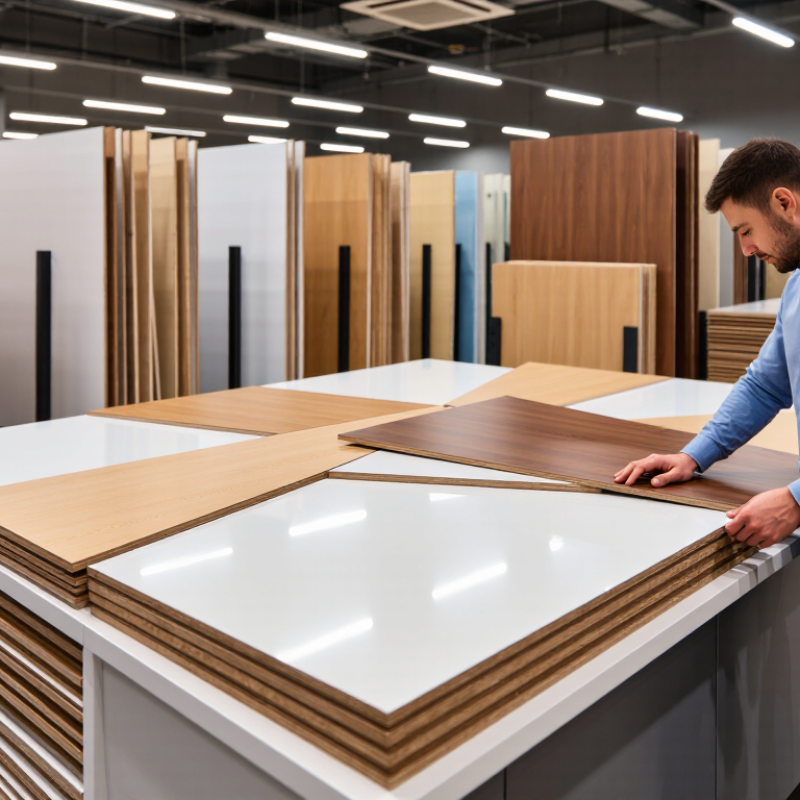
Before comparing prices, define how the melamine faced plywood will work in your project. A kitchen cabinet, retail shelf, and bathroom vanity need different specifications. Write down the panel thickness, finished dimensions, color, surface texture, and expected load. Small details matter.
I once selected a panel by appearance alone. The finish looked excellent, but the core was unsuitable for long shelves. Now I check the plywood grade, veneer quality, bonding performance, and thickness tolerance. Measure the available space carefully.
A panel listed as 18 millimeters may have slight manufacturing variation. Confirm the actual tolerance with technical documents or a physical sample. For shelves, calculate span and load before ordering. Heavy books need stronger support or closer spacing.
Think about moisture exposure, edge treatment, and machining requirements. Melamine resists everyday surface stains, but exposed edges still need protection. In a humid room, ask for documented moisture-related performance rather than relying on assumptions. Check whether the panel can be cut, drilled, and edged without chipping. Request information about surface durability, emissions, and applicable quality standards. It is also wise to inspect several sheets for color consistency and flatness. One sample can hide batch variation. That mistake is easy to make. Keep your project notes, drawings, and supplier confirmations together, so every panel specification can be checked before production.
A stable, multi-layer plywood core should show tight, even plies without large gaps.
Birch-based cores often provide strong screw holding, while lighter cores can reduce cabinet weight.
Small variations may cause uneven doors or exposed joints. Measure several points, not just one.
It should look uniform, without bubbles, scratches, or cloudy patches.
A textured face can hide fingerprints, while a smooth face is easier to clean. Choose based on actual use.
“Water-resistant” is not the same as waterproof, and reliable documents matter more than sales language.
Poor edge sealing can allow moisture into the core. Pre-drilling may prevent chipping, although the correct bit still matters.
In workshop checks, appearance often gets too much attention. I have seen attractive panels fail because their cores were weak or uneven. That mistake is easy to repeat. Compare flatness, core quality, surface durability, and intended room conditions before making the final choice.
Thickness should match the load, span, and fixing method. Common options include 6, 9, 12, 15, and 18 millimetres. Thicker panels resist bending better, but they also increase cabinet weight. The USDA Forest Service Wood Handbook (2021) explains that plywood uses three or more veneer layers, improving dimensional stability through cross-grain construction. Do not trust the printed thickness alone. Measure several points with calipers. Small variations can affect hinges and drawer alignment.
Dimensions deserve equal attention. Standard sheets often measure 1220 × 2440 millimetres, while larger formats may reach 1220 × 3050 millimetres. Check actual size, squareness, and diagonal differences before cutting. A 3-millimetre error can become obvious across a tall wardrobe. Confirm tolerances against EN 315 or the supplier’s verified technical sheet. Edges should be straight, sealed, and free from exposed core gaps. Tongue-and-groove edges help flooring applications, but plain edges suit many cabinet panels.
Finish quality is more than a smooth, attractive face. Inspect the melamine under diffuse daylight. Look for bubbles, pinholes, shade changes, chipped corners, and visible sanding marks. Run a fingernail across the edge banding. It should not lift easily. The USDA handbook links moisture movement with warping and surface stress, so store panels flat and dry. My practical mistake was checking only the front face. The rear face and cut edges later showed weak adhesion. Look closely. Surface appearance can hide poor bonding.
When buying melamine faced plywood, start by defining where it will be used. Furniture for a bedroom needs stricter emission control than temporary shop shelving. Ask for the applicable safety standard, not just a general “safe” claim. The document should identify the product, thickness, test method, test date, and issuing laboratory. Check whether the certification covers the exact panel, not another product from the same factory. Also verify that the certificate remains valid. Paperwork can look convincing.
Examine formaldehyde results carefully. An emission class may differ between regions, so compare it with your local requirements. Request a recent batch test, especially when purchasing large quantities. Look for independent laboratory results rather than an unsigned supplier statement. Inspect sealed edges and damaged surfaces, because exposed core layers may release odors and absorb moisture. Keep panels in a dry, ventilated area before installation. Strong odor is a warning, but low odor alone proves little. I once underestimated storage conditions; even compliant boards can smell worse in a warm, closed room. Ask about adhesive composition, ventilation advice, and after-sales traceability. A careful buyer records the batch number and keeps every test document. This feels slow, but it prevents expensive assumptions.
Check the safety standard, certification documents, formaldehyde test method, emission class, thickness, surface quality, and batch traceability before purchasing.
Formaldehyde emission limits shown below are from GB/T 39600-2021. Lower values indicate stricter emission requirements. Results from different standards and test methods should not be compared directly without checking the stated testing conditions.
Buying melamine faced plywood requires more than comparing catalogue photos. Tip: Check supplier experience, production capacity, and quality records. Ask how core materials, melamine papers, and edge treatments are controlled. A dependable supplier should provide clear product specifications and answer technical questions without vague promises. Tip: Request recent samples from the same production line. Inspect the surface under angled light. Look for color consistency, flatness, chipped edges, and weak bonding. One attractive sample proves little.
Tip: Compare pricing by matching thickness, core grade, face finish, panel size, packaging, and delivery terms. The cheapest quotation may exclude moisture-resistant treatment or protective packing. Ask for a written cost breakdown. Tip: Order a small trial batch before committing to a larger purchase. Test screw holding, cutting behavior, edge chipping, and surface durability in your own workshop. My earlier mistake was trusting a smooth sample without testing the cut edges.
Tip: Confirm minimum order quantities and production lead times in writing. Delays can disrupt cabinet schedules and storage plans. Tip: Read warranty terms carefully. Check the coverage period, acceptable defects, claim evidence, response time, and replacement process. Ask whether improper storage or installation limits coverage. Tip: Keep invoices, batch details, inspection photos, and delivery records. These details make disagreements easier to investigate. Still, warranty language can be imperfect, so clarify unclear clauses before payment. A short email now may prevent an expensive argument later.
Use this comparison guide to screen suppliers and compare like-for-like offers. Prices are indicative international purchasing ranges and vary with thickness, grade, order volume, surface finish, certification, packaging, freight, and destination.
| Tip | Evaluation Dimension | What to Check | Practical Benchmark or Requirement | Recommended Buyer Action |
|---|---|---|---|---|
| 1 | Confirm the panel specification | Check nominal thickness, panel dimensions, plywood core construction, melamine surface type, face and back color, surface texture, glue line quality, and intended use. | Common commercial thicknesses include approximately 6–25 mm. The stated thickness tolerance and core grade should be included in the quotation or technical data sheet. | Send one written specification to every supplier so quotations are based on the same product. Do not compare a hardwood-core panel with a lower-grade mixed-core panel solely by price. |
| 2 | Evaluate supplier capability | Review production experience, quality-control procedures, export history, monthly capacity, equipment, packaging methods, and ability to maintain consistent color and thickness between batches. | Prefer suppliers that can provide a traceable inspection process, batch records, loading photographs, and a clearly identified contact for quality claims. | Request product photographs, a current technical data sheet, inspection records, and two or more recent shipment references with confidential information removed. |
| 3 | Compare the total landed cost | Separate panel price from inland transport, export packing, documentation, insurance, ocean freight, duties, taxes, and destination delivery. | For broad planning purposes, standard melamine-faced plywood may be quoted around US$15–45 per 1.22 × 2.44 m panel, depending strongly on specification and volume. This is not a universal market price. | Ask for both an ex-works or port price and a delivered price. Confirm currency, Incoterm, quotation validity, minimum order quantity, payment schedule, and all possible surcharges. |
| 4 | Order and inspect samples | Assess color consistency, gloss or texture, edge quality, flatness, core voids, delamination, scratches, chips, odor, and machining behavior. | Request samples from the same production specification and, where possible, from a normal production batch rather than only a showroom sample. | Compare the sample with the approved reference under natural and indoor lighting. Record the approved color, texture, thickness, and acceptable defect limits in the purchase order. |
| 5 | Verify performance and compliance | Check moisture resistance, bonding quality, formaldehyde-emission documentation, structural grade, surface durability, and suitability for furniture, cabinetry, wall panels, or other applications. | Ask for test reports issued to the same product type. Formaldehyde classifications and test methods differ by market, so the requirement must match the destination regulations. | Do not accept a generic certificate without confirming the product name, test method, test date, thickness range, and issuing laboratory. Arrange independent testing for large or safety-critical orders. |
| 6 | Review lead time and logistics | Confirm production time, sample time, port of loading, container loading quantity, packaging, moisture protection, labeling, and documents supplied with each shipment. | A typical production estimate may be approximately 15–35 days after specification and payment approval, excluding sampling, booking, customs, and ocean transit. Actual timing depends on order size and season. | Put the latest acceptable shipment date and delay-notification procedure in writing. Request moisture-resistant packaging and corner protection suitable for the planned transport route. |
| 7 | Negotiate warranty and claims terms | Clarify coverage for delamination, abnormal warping, incorrect dimensions, wrong color, surface defects, damaged packaging, and nonconformity with the approved sample. | A written warranty is commonly negotiated for 6–12 months from shipment or delivery, but the exact period and starting point must be stated explicitly. | Require a claim procedure, evidence requirements, response time, inspection method, remedy options, and responsibility for replacement, credit, rework, or reasonable inspection costs. |
Note: Pricing, lead times, warranty periods, and performance requirements are indicative purchasing benchmarks rather than fixed industry standards. Always confirm current terms with the supplier and applicable local regulations before placing an order.
880 W 9th Street
Upland, California 91786
884 W 9th Street
Upland, California 91786
886 W 9th Street
Upland, California 91786
884 W 9th Street
Upland, California 91786