
Choosing Commercial Flood Lights is not simply a matter of picking the brightest fixture. A parking area needs broad, even coverage, while a loading dock may need a tighter beam aimed at doors and vehicle paths. Picture a rainy evening: light reflects off wet pavement, shadows gather beside a wall, and glare can make visibility worse. Small details matter.
A useful comparison starts with the site. Check lumen output, beam angle, mounting height, color temperature, and the fixture’s stated weather resistance. Numbers need context. A high lumen rating alone does not guarantee useful light if the beam misses the target or creates harsh glare. Look for clear manufacturer specifications, warranty terms, and practical information about installation and maintenance. For outdoor locations, consider exposure to water, dust, vibration, and temperature changes.
This guide explores which Commercial Flood Lights may suit different commercial settings, from building entrances to sports grounds and warehouse yards. It also considers energy use, controls, durability, and total ownership costs—not just the purchase price. There is no single best option for every site. Even a careful shortlist can miss something; a real nighttime check often reveals dark corners that a product chart cannot. The goal is to compare fixtures against actual needs and make a confident, informed choice.
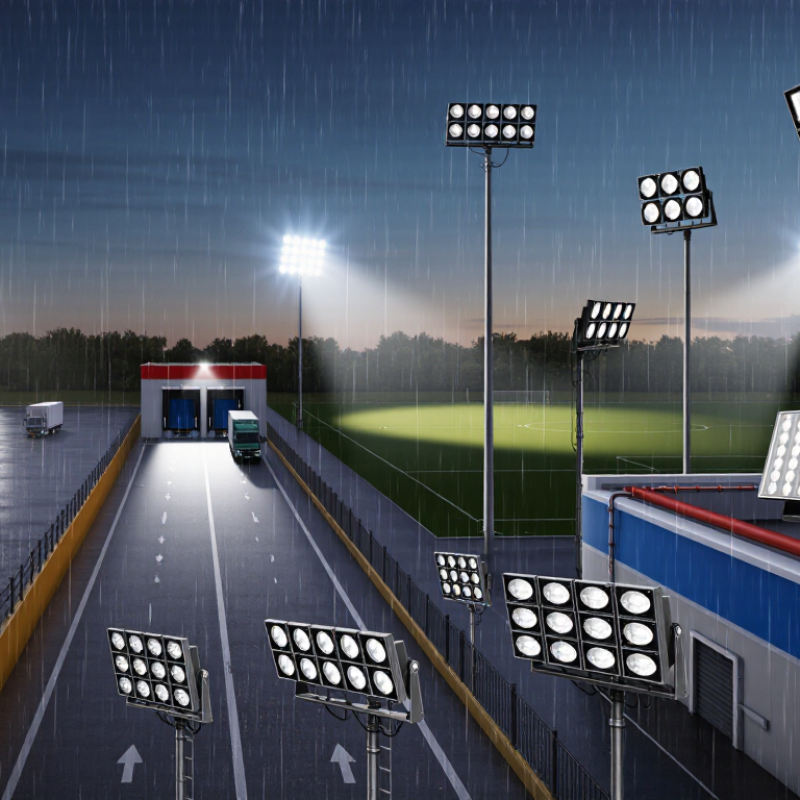
What Are the Best Commercial Flood Lights?
What Defines a Commercial Flood Light?
A commercial flood light is built to illuminate broad outdoor areas, such as loading zones, building entrances, and parking lots. Its defining feature is not simply high wattage. Check the lumen output, beam angle, and light distribution together. A narrow beam can leave dark gaps, while a wider beam may spill light beyond the target. Good fixtures manage heat, resist weather, and maintain steady output during long operating hours. Look for a suitable ingress protection rating for the installation location, plus a housing designed to handle rain, dust, and temperature changes. Details matter.
Tips: Compare usable lumens, not watts alone. Review the fixture’s photometric layout and mounting height before choosing. A sample installation can reveal glare or dark patches that a product sheet may not show.
Controls and maintenance also help define a commercial-grade fixture. Dimming, motion sensing, or scheduled operation can reduce unnecessary use when compatible with site needs. Ask about expected service life and how output changes over time; initial brightness is only part of the picture. Match color temperature to the task and surroundings. Cooler light can make edges easier to distinguish, but it may feel harsh near homes. There is no perfect setting for every site, and even a well-specified light can disappoint if aimed poorly.
| Specification | Typical Commercial Range | What It Defines | Selection Guidance |
|---|---|---|---|
| Light source | LED is the most common choice in new installations. | Commercial flood lights are designed to provide broad, high-intensity illumination for outdoor or large-area applications. | Look for a fixture with documented photometric data and replaceable or serviceable components where maintenance access matters. |
| Luminous output | About 5,000–60,000 lumens, depending on fixture size and application. | Lumens measure the total visible light produced by the fixture. | Choose output based on mounting height, area size, required illuminance, and a lighting layout—not wattage alone. |
| Efficacy | Roughly 100–150 lumens per watt for many commercial LED fixtures. | Efficacy indicates how much light is produced for each watt of electricity used. | Compare tested fixture efficacy alongside light distribution, glare control, and expected operating conditions. |
| Beam distribution | Common distributions range from narrow beams around 10°–30° to wide beams around 60°–120°. | Beam angle and optical distribution determine where light is directed and how evenly an area is covered. | Use narrower optics for long-distance or targeted lighting and wider optics for broad coverage; verify aiming and spill-light limits. |
| Ingress protection | IP65 is common; IP66 is used where stronger water-jet resistance is needed. | The IP rating describes protection against dust and water under specified test conditions. | For exposed outdoor locations, confirm the rating is for the complete assembled fixture and suits the actual cleaning and weather conditions. |
| Impact resistance | IK08 or IK10 may be specified for fixtures exposed to impact risks. | The IK rating indicates resistance to mechanical impact; higher numbers indicate greater tested impact resistance. | Consider a higher rating for sports facilities, public spaces, loading areas, or locations where equipment may be struck. |
| Color temperature | Common options are 3000 K, 4000 K, and 5000 K. | Correlated color temperature describes whether the light appears warmer or cooler. | Choose a consistent color temperature across the site and consider local requirements for outdoor lighting and light pollution. |
| Color rendering | CRI 70 or higher is common for general outdoor applications; CRI 80 or higher may suit color-critical tasks. | CRI describes how accurately colors appear under a light source compared with a reference source. | Use a higher CRI where workers need to distinguish colors, inspect surfaces, or identify objects accurately. |
| Electrical supply | Commercial models may support 120–277 V or 277–480 V, depending on the fixture. | Input-voltage compatibility determines whether the fixture can connect to the site’s electrical system. | Check the full input-voltage range, local electrical code, driver compatibility, and available circuit before ordering. |
| Controls and dimming | Options may include 0–10 V dimming, photocells, occupancy controls, or networked controls. | Controls can reduce energy use and adjust lighting to schedules, daylight, or occupancy. | Confirm control protocols and sensor compatibility; not every fixture includes controls as standard. |
| Surge protection | Protection levels vary by design; some fixtures specify internal surge protection in kilovolts. | Surge protection helps reduce damage from transient voltage events, including some lightning-related surges. | Review the rated protection level and consider additional site-level protection where exposure or electrical risk is high. |
| Service life | Many LED fixtures publish an estimated L70 life in the range of 50,000–100,000 hours. | L70 is the estimated operating time until light output reaches 70% of its initial level under stated conditions. | Check the test basis, ambient temperature, driver life, and warranty terms; rated life is not a guarantee of failure-free operation. |
| Thermal and environmental limits | Operating-temperature limits are model-specific and often cover sub-zero to hot outdoor conditions. | Thermal design affects performance and service life, particularly in enclosed or high-temperature locations. | Verify the fixture’s stated ambient-temperature range for the actual installation site and mounting arrangement. |
| Mounting and aiming | Common arrangements include yoke, slipfitter, and wall or pole mounting options. | Mounting hardware determines how securely the fixture attaches and how accurately it can be aimed. | Check pole or wall compatibility, wind exposure, adjustment range, and the fixture’s weight before installation. |
| Best-fit applications | Parking lots, building facades, loading areas, sports grounds, yards, and security perimeters. | A commercial fixture is selected for the required coverage, durability, operating schedule, and site conditions. | The best option is the one that meets the project’s lighting design, safety, energy, environmental, and maintenance requirements. |