
Industrial evaporation turns a liquid feed into a more concentrated product by removing water or another solvent. Industrial evaporators make this operation faster, steadier, and easier to control. They are used in food processing, dairy production, chemicals, pharmaceuticals, and wastewater treatment. Each application demands careful equipment selection.
Evaporation Evaporators can provide strong heat transfer within a compact footprint. Falling-film models suit heat-sensitive liquids because products move quickly through heated tubes. Forced-circulation units handle viscous feeds and reduce the risk of localized boiling. Under vacuum, evaporation can occur at lower temperatures. This protects flavor, color, and active ingredients.
Efficiency is not automatic. A poorly sized evaporator may consume excess steam, foul rapidly, or produce uneven concentration. Experienced engineers review feed viscosity, solids content, boiling-point elevation, and cleaning requirements before choosing a design. They also examine steam economy and opportunities for vapor recompression. Small details matter. A blocked tube can disrupt an entire shift.
Reliable performance depends on verified data, practical testing, and disciplined maintenance. Operators should monitor temperature, pressure, flow rate, product density, and energy use. Trial runs can reveal behavior that laboratory measurements miss. Some assumptions fail in production. That is why manufacturers and plant teams should compare performance under realistic operating conditions. The right industrial evaporator can reduce operating costs, stabilize product quality, and support safer, more sustainable processing. Its value comes from fit, not appearance.
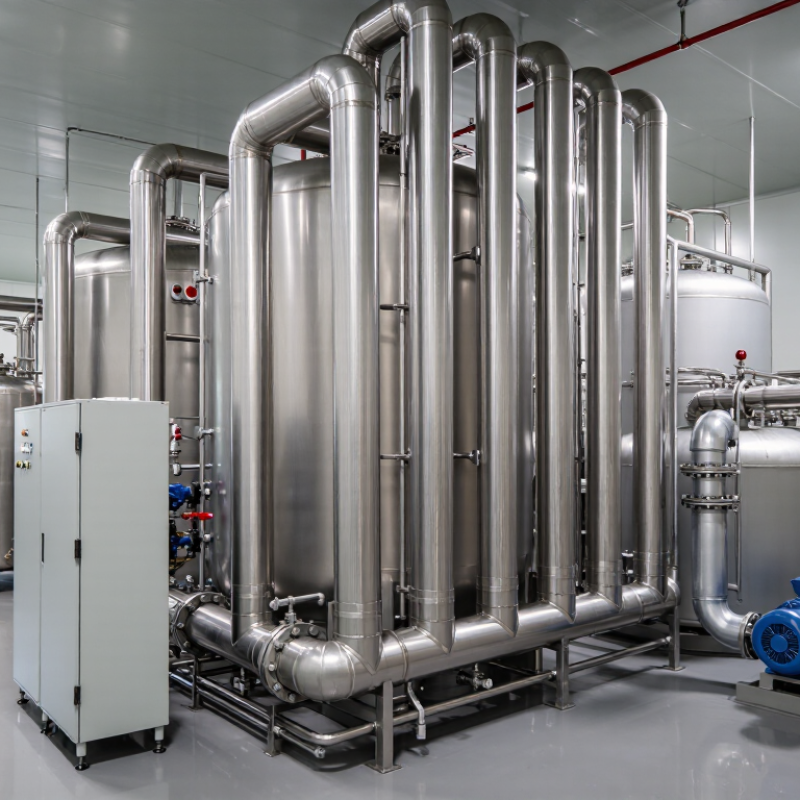
Industrial evaporators are process systems that remove water or other solvents from liquid mixtures. They are common in food processing, chemical production, wastewater treatment, and pharmaceutical manufacturing. Their purpose is simple: concentrate a solution while controlling heat, pressure, and product quality.
Inside an evaporator, a heat exchanger transfers energy into the liquid. The solvent reaches its boiling point and changes into vapor. A separator then removes vapor from the thicker liquid. Under vacuum, boiling occurs at a lower temperature. This helps protect heat-sensitive materials. The vapor may pass through a condenser, where it becomes liquid again. Pumps, sensors, and control valves keep flow and temperature within set limits.
Real plants are less tidy. Mineral deposits can build up on heating surfaces and reduce efficiency. Operators often inspect temperature differences, pressure readings, and product concentration during production. A calculated heat-transfer rate is never the whole story. Feed composition can change within a single shift. That change may affect viscosity, foaming, and energy demand. Cleaning schedules must match actual fouling conditions, not only laboratory predictions. Poor control can cause scorching, unstable flow, or an overly thick product. Small details matter. A reliable design therefore considers residence time, material compatibility, vapor handling, and safe pressure control. Experienced teams also review operating data after each batch, because equipment performance can quietly drift over time.
Industrial evaporators remove water or another volatile solvent from a solution by transferring heat to the liquid. The comparison below summarizes common evaporator configurations and their typical operating characteristics. Actual performance depends on feed properties, plant design, utilities, and operating conditions.
| Evaporator Type | How It Works | Best-Suited Feed | Typical Operating Range | Indicative Steam Consumption* | Main Advantages | Key Considerations |
|---|---|---|---|---|---|---|
| Single-Effect Evaporator | Steam heats the product in one effect. The generated vapor is normally condensed and is not reused for additional evaporation. | Small-capacity operations, intermittent production, and applications with low steam cost. | Product boiling temperature commonly ranges from approximately 50–120 °C, depending on vacuum and product sensitivity. | Approximately 0.8–1.2 kg of steam per kg of water evaporated. | Simple layout, lower initial cost, easy operation, and flexible batch or continuous use. | Highest thermal energy demand among the configurations listed. |
| Multiple-Effect Evaporator | Vapor produced in one effect supplies heat to the next effect operating at a lower pressure and boiling temperature. | Large, continuous-duty plants where steam economy is important. | Usually configured with 2–7 effects; the temperature decreases progressively from effect to effect. | Approximately 0.15–0.50 kg of steam per kg of water evaporated, depending on the number of effects and heat losses. | Substantially improved steam economy and lower operating cost for high-throughput applications. | Higher capital cost, more complex controls, and greater sensitivity to fouling or production changes. |
| Falling-Film Evaporator | Feed enters at the top and forms a thin film flowing downward over heated tubes while solvent evaporates rapidly. | Low- to medium-viscosity liquids and heat-sensitive food, dairy, pharmaceutical, and chemical products. | Often operates under vacuum with short product residence times, commonly from seconds to a few minutes. | Varies with effect arrangement; approximately 0.15–0.50 kg/kg in multi-effect systems. | Good heat transfer, short residence time, relatively low product damage, and high capacity per unit area. | Requires reliable liquid distribution and may be unsuitable for highly viscous or heavily fouling feeds. |
| Rising-Film Evaporator | Vapor bubbles form inside heated tubes and lift the liquid upward, creating a rising film and promoting circulation. | Low-viscosity, relatively clean liquids with stable boiling behavior. | Commonly used under vacuum to reduce boiling temperature and protect heat-sensitive materials. | Typically approximately 0.15–0.50 kg/kg when integrated into a multi-effect system. | Efficient natural circulation, relatively simple construction, and effective heat transfer at suitable loads. | Performance can decline at low throughput, high viscosity, or excessive fouling. |
| Forced-Circulation Evaporator | A circulation pump drives the liquid through a heat exchanger; evaporation occurs mainly in a flash vessel after pressure reduction. | High-viscosity, crystallizing, scaling, or fouling liquids. | Can handle elevated circulation rates and controlled vacuum operation; product temperatures depend on feed sensitivity. | Approximately 0.15–0.60 kg/kg in multi-effect arrangements, excluding electrical pumping energy. | Good control of circulation, reduced risk of tube dry-out, and suitability for difficult feeds. | Higher pumping power, larger equipment footprint, and more mechanical components. |
| Mechanical Vapor Recompression (MVR) | A compressor raises the pressure and temperature of generated vapor so it can be reused as the heating medium. | Large continuous operations with stable loads and high annual operating hours. | Often uses a relatively small temperature lift, commonly about 5–15 °C, depending on system design. | External steam demand can be approximately 0.02–0.10 kg/kg during steady operation; electricity use is significant. | Very low ongoing steam consumption, reduced cooling-water demand, and strong potential for lower emissions. | Higher capital cost, dependence on electricity pricing, and the need for compressor maintenance. |
| Scraped-Surface Evaporator | Rotating blades continuously renew the heated surface, maintain product movement, and remove deposits from the heat-transfer wall. | Very viscous, sticky, shear-sensitive, or fouling products. | Operating temperature and vacuum are selected according to viscosity, fouling tendency, and product sensitivity. | Highly application-dependent; generally higher energy use per unit capacity than thin-film systems. | Maintains heat transfer with difficult products and reduces buildup on the heating surface. | More moving parts, higher maintenance requirements, and typically lower throughput per unit area. |
*Note: Steam-consumption figures are indicative engineering ranges expressed as kilograms of external steam per kilogram of water evaporated. They vary with the number of effects, feed concentration, boiling-point elevation, heat recovery, vacuum level, fouling, condensate return, and plant operating conditions.