
Choosing the right Color Coated Steel Coil can shape a project’s durability, appearance, and maintenance cost. The decision is not simply about selecting a popular color. It involves substrate strength, coating thickness, paint chemistry, forming requirements, and exposure conditions. A roofing panel near a humid coastline faces salt, wind, and strong sunlight. An indoor partition may need far less protection.
Materials expert Dr. J. R. Davis has stated, “The performance of a coating depends on the substrate, the environment, and the application.” This principle remains practical. A coil with a thicker paint layer may look safer, but thickness alone does not guarantee service life. Galvanizing quality, surface preparation, resin type, curing control, and edge protection also matter. Small details matter.
This guide explains how to compare Color Coated Steel Coil options before placing an order. It examines steel grade, zinc or aluminum-zinc coating, paint system, gloss, color consistency, and minimum bending radius. It also considers climate, building use, fabrication methods, and supplier documentation. Request technical data sheets, test reports, and sample pieces. Touch the surface. Check the reverse side. Inspect cut edges after forming.
A perfect specification on paper can still fail during installation. That uncomfortable possibility deserves attention. Some buyers focus heavily on price and underestimate repainting, replacement, or premature corrosion. Others select a premium coating without confirming whether it suits their forming process. The better choice balances performance, budget, appearance, and realistic site conditions. This is where careful questioning becomes more valuable than a quick quotation.
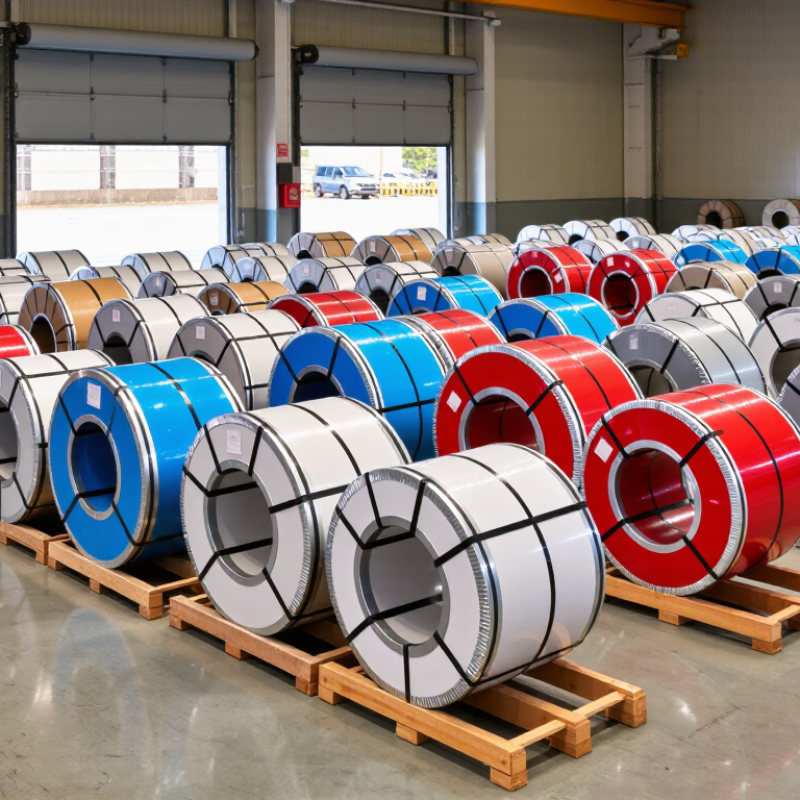
Your project conditions should guide every steel coil decision. Start with the building’s location, purpose, and expected service life. Coastal sites need stronger corrosion protection because salt air attacks exposed edges quickly. Industrial areas may require coatings that resist chemicals, moisture, and frequent cleaning.
The substrate also matters. Galvanized steel suits many construction applications, while heavier zinc coatings can provide additional protection. Check the required yield strength before ordering. A coil for roofing may need different forming performance than one for wall panels or equipment housings. Confirm the coating thickness, paint system, color tolerance, gloss level, and surface finish with the supplier. Small differences can affect appearance across large panels.
I once underestimated edge exposure on a warehouse project. The main surface performed well, but cut edges needed better protection. That mistake changed our inspection checklist. Requirements are not always obvious.
Tips: Measure the intended bend radius before selecting the coil. Ask for technical data, coating test results, and sample panels. Compare the coil width with your cutting plan to reduce waste. Record batch numbers during delivery. Inspect the surface under natural light, not only under bright warehouse lamps. Also check packaging carefully. Damp storage can damage even a suitable coating. Consider local weather records, fabrication equipment, maintenance access, and transport conditions before final approval.
Choosing a color coated steel coil starts with service conditions, not appearance. A coastal roof faces salt, humidity, and strong ultraviolet exposure. An indoor partition may need less corrosion protection. The World Steel Association reported global crude steel production at about 1.89 billion tonnes in 2023. This scale makes specification discipline important, because small property differences affect large projects.
Compare the metallic coating mass first. Under EN 10346, a Z275 coating contains 275 g/m² of zinc across both surfaces. Higher coating mass can improve corrosion resistance, but it may influence forming behavior and cost. Check the steel grade and yield strength as well. A stronger coil is not always better. It can crack during tight bends. Paint thickness, adhesion, gloss retention, and color difference also deserve testing. EN 10169 provides a useful framework for organic-coated flat steel products.
Corrosion category matters more than a sales phrase. ISO 12944 classifies environments from low exposure to severe industrial and marine conditions. Ask for test evidence, not only a promised service life. ASTM D3359 adhesion testing and bend testing can reveal weak interfaces before installation. On site, inspect cut edges, punched holes, and damaged corners. These areas often fail first. The report may look excellent.
A practical comparison should include coil width tolerance, flatness, forming radius, and batch traceability. Use the same test methods for every supplier. Data sheets sometimes omit humidity-cycle results, which is a warning sign. I would also request a sample panel and expose it near the actual project. Laboratory results guide decisions, but real weather can be less polite.
| Property to Compare | Typical Data or Options | Why It Matters | Recommended Selection Guidance |
|---|---|---|---|
| Base Steel Grade | Forming grades: approximately 220–280 MPa yield strength Structural grades: approximately 280–550 MPa yield strength | Determines load-bearing capacity, flexibility, and resistance to permanent deformation. | Use a forming grade for roll forming and deep bending. Use a structural grade for roofing, wall panels, and load-bearing applications after engineering verification. |
| Tensile Strength | Common commercial range: approximately 300–650 MPa | Indicates the maximum stress the steel can withstand before breaking. | Select according to structural calculations, wind loads, span requirements, and forming equipment limitations. |
| Metallic Coating Type | Hot-dip zinc coating Aluminium-zinc alloy coating Zinc-aluminium-magnesium coating | Provides sacrificial and barrier protection against corrosion. | Choose the coating system based on humidity, salt exposure, condensation, pollution, and expected service life. |
| Metallic Coating Mass | Typical total coating mass: approximately 60–350 g/m², depending on coating type and specification | A higher coating mass generally provides greater corrosion protection, although actual performance also depends on the environment and paint system. | Specify the coating mass according to the applicable standard and corrosion category rather than choosing only by appearance. |
| Organic Coating System | Polyester: economical general-purpose system Silicone-modified polyester: improved weathering and hardness High-durability polyester: enhanced exterior durability PVDF: high weathering and color-retention performance | Controls resistance to UV radiation, fading, chalking, scratching, chemicals, and outdoor aging. | Use polyester for standard indoor or moderate outdoor service. Consider higher-durability systems for severe sunlight, coastal exposure, or long design life. |
| Topcoat Thickness | Common range: approximately 15–30 μm High-durability systems may use thicker or multi-layer coatings | Affects coverage, color consistency, abrasion resistance, and long-term weathering performance. | Confirm nominal and minimum dry-film thickness on the purchase specification, including the reverse-side coating. |
| Primer and Backing Coat | Primer commonly approximately 5–10 μm; backing coat commonly approximately 5–15 μm | Improves adhesion, corrosion resistance, and protection of the concealed or reverse surface. | Specify the reverse-side coating when the coil will be used for panels, sandwich construction, or humid interior spaces. |
| Formability and Bending | Typical indoor panel forming requirement: 1T–2T bend radius Stronger grades may require a larger radius | Insufficient formability can cause coating cracking, delamination, or substrate failure during profiling. | Match the steel grade and coating flexibility with the smallest radius, profile depth, and forming speed required by the project. |
| Color and Gloss | Gloss levels commonly specified as low, medium, or high; color tolerance should be agreed using an approved sample or color measurement system. | Controls visual uniformity between coils, production lots, and installed panels. | Approve a control sample and define acceptable color and gloss tolerances before mass production. |
| UV and Color Retention | Performance is classified by the coating system, resin chemistry, pigment selection, exposure level, and applicable test standard. | Strong sunlight can cause fading, chalking, gloss loss, and gradual coating degradation. | For high-solar-radiation regions, select a coating with documented exterior durability and obtain test classification or warranty requirements. |
| Corrosion Environment | Indoor dry: low exposure Urban or industrial: moderate exposure Coastal or high-humidity: severe exposure | The surrounding environment determines the required metallic coating, paint system, edge protection, and maintenance interval. | Identify the project corrosion category using the relevant local or international standard before selecting the coil. |
| Nominal Thickness | Common construction range: approximately 0.30–1.20 mm | Affects panel stiffness, weight, span capability, handling, and forming behavior. | Select thickness using structural calculations and profile design; do not substitute coating mass for steel thickness. |
| Width and Dimensional Tolerance | Typical supplied widths: approximately 600–1,250 mm; tolerances depend on thickness, width, and the governing standard. | Correct dimensions reduce trimming waste and help maintain consistent panel geometry. | Define width, thickness, flatness, camber, edge condition, and tolerance requirements in the order specification. |
| Fire and Building-Code Requirements | Depends on the complete building assembly, including insulation, core, joints, fasteners, and coatings. | A steel coil specification alone does not determine the fire performance of a finished roof or wall system. | Request assembly-level fire-test evidence where required by local building regulations. |
| Quality Documentation | Mill test certificate, coating thickness report, mechanical test results, color approval, and inspection records | Verifies that the delivered coil matches the specified mechanical, dimensional, and coating requirements. | Require documentation referencing the applicable standard, batch number, measured values, and inspection criteria. |
Note: The values shown are typical industry ranges for preliminary comparison only. Final requirements should be confirmed against the applicable product standard, structural design, environmental exposure, forming process, and local building regulations.
How to Choose Color Coated Steel Coil for Your Project?
Selecting the right coating starts with understanding the service environment. A coastal building faces salt, moisture, and strong sunlight. An indoor partition may need less corrosion protection. Match the coating system to these conditions, not only to the lowest price. Check the substrate, primer, topcoat, and reverse-side coating. A properly galvanized substrate can improve long-term protection. For roofs and wall panels, consider forming requirements before ordering. A coating that cracks during bending will fail early.
Tips: Ask for coating thickness records. Request test results for adhesion, impact, and corrosion resistance. Compare color samples in daylight. Dark colors can absorb more heat, while light colors may show dirt sooner. Choose the finish carefully. Glossy surfaces reflect light and highlight small marks. Matte finishes can look calmer, but cleaning may be less predictable.
Color consistency matters across different production batches. Keep an approved sample and record its color reference. Inspect the coil edges, surface, and packaging when it arrives. Look for scratches, dents, oil stains, or uneven paint. A quick visual check helps, but it cannot replace documented testing. In practice, project teams sometimes focus too heavily on color and overlook bending performance. That mistake is easy to make. Review the supplier’s technical data, storage guidance, and warranty conditions before production begins.
Select the right coating system, color, and surface finish by balancing durability, appearance, forming requirements, and environmental exposure.
The chart uses representative industry thickness ranges for common organic coatings. Actual specifications vary by supplier, substrate, exposure category, forming requirements, and project standards.
PE is commonly selected for general architectural use. SMP and HDP offer improved resistance to weathering and chalking, while PVDF is typically chosen for demanding exterior applications and long-term color retention.
Light colors generally absorb less solar radiation than dark colors. Confirm the required color reference, solar reflectance, and batch consistency before production.
Choose a smooth, embossed, or matt finish according to the required appearance, scratch visibility, forming behavior, and cleaning conditions.
How to Choose Color Coated Steel Coil for Your Project?
Matching Coil Specifications to Fabrication and Installation Needs
Choosing color coated steel coil starts with the finished building, not the color chart. Confirm the forming method, panel profile, span, fastener type, and site exposure. A roll-forming line may need tighter thickness tolerances than simple flashing work. For deep drawing, select a substrate with suitable elongation and yield strength. The wrong grade can crack around bends or spring back during profiling.
Coating selection should match the environment. Coastal air, industrial emissions, and trapped moisture can shorten service life. The NACE IMPACT study estimated global corrosion costs at US$2.5 trillion annually, equal to about 3.4% of global GDP. This figure shows why paint chemistry and metallic coating weight deserve careful attention. Specify the coating system, topcoat thickness, back-coat type, gloss, and warranty conditions. ISO 12944 exposure categories can also support a more disciplined corrosion assessment. They are useful, but not a substitute for a site inspection.
Tips: Request mill certificates and test results before production. Check thickness, yield strength, coating mass, color difference, and bend performance. Keep coils dry and separated during storage. Small errors become visible on long façades. I have seen installers focus on appearance while ignoring edge protection. That is an avoidable weakness. The 2024 World Steel Association report recorded roughly 1.88 billion tonnes of global crude steel production, yet volume alone says little about coil suitability. Project-specific specifications still matter more.
Choosing a color coated steel coil starts with measurable quality, not color alone. Check substrate thickness, coating mass, paint thickness, surface uniformity, and edge condition. Request mill test certificates, coating test results, and batch traceability. ISO 12944-5:2018 helps match coating systems with exposure environments, such as coastal or industrial areas. ASTM A755/A755M also provides guidance for steel sheet with metallic and organic coatings.
Supplier reliability matters during delivery, storage, and claims. Ask for recent inspection records, production capacity, and a clear replacement procedure. The World Steel Association reported 1,888.2 million tonnes of crude steel production in 2023. That scale shows why supply consistency must be verified, not assumed. A large producer may still offer inconsistent batches. I have seen samples look identical under warehouse lighting, then show different gloss after installation.
Tips: Compare at least three samples under daylight and cold-white lighting. Measure coating thickness independently when the project is critical. Check packaging, coil weight, inner diameter, and loading photos before shipment. Keep spare material for future repairs.
Total cost includes more than the purchase price. Add freight, storage, slitting, installation waste, repainting risk, and delayed delivery. A cheaper coil can become expensive after early fading or poor forming performance. Ask whether the quoted tolerance matches your equipment. Review warranty terms carefully, especially exclusions for cutting, bending, and improper storage. Worldsteel’s industry data confirms steel is produced at enormous volume, but volume does not guarantee project-level reliability. Supplier audits and small trial orders remain worthwhile.
880 W 9th Street
Upland, California 91786
884 W 9th Street
Upland, California 91786
886 W 9th Street
Upland, California 91786
884 W 9th Street
Upland, California 91786