
China’s portable EV charging market is expanding, but a manufacturer’s headline power rating tells only part of the story. A Portable Ev Station must also be practical to move, straightforward to connect, and dependable when temperatures shift or charging locations change. Buyers should look closely at output options, connector compatibility, battery capacity, protection features, and the time needed to set up the unit. Small details matter. A heavy enclosure can turn a promising product into a poor fit for roadside support or temporary events.
EV charging analyst Colin McKerracher has emphasized the importance of convenient charging access in the shift to electric vehicles. Applied to portable equipment, that principle suggests a useful question: does the station solve a real charging problem, or merely advertise impressive specifications? This guide compares leading Chinese manufacturers through product design, technical documentation, quality controls, customization, and after-sales support. It also considers how clearly each supplier explains operating limits and intended use. Those details are not glamorous, but they help buyers judge whether a product fits their vehicles and working conditions.
No manufacturer is best for every buyer. Some prioritize compact equipment; others focus on higher output or fleet applications. Specifications can also be difficult to compare across product lines. That deserves scrutiny. The following overview offers a practical starting point for evaluating China’s top portable EV station manufacturers, while encouraging readers to verify current certifications, test reports, and product configurations directly with each supplier.
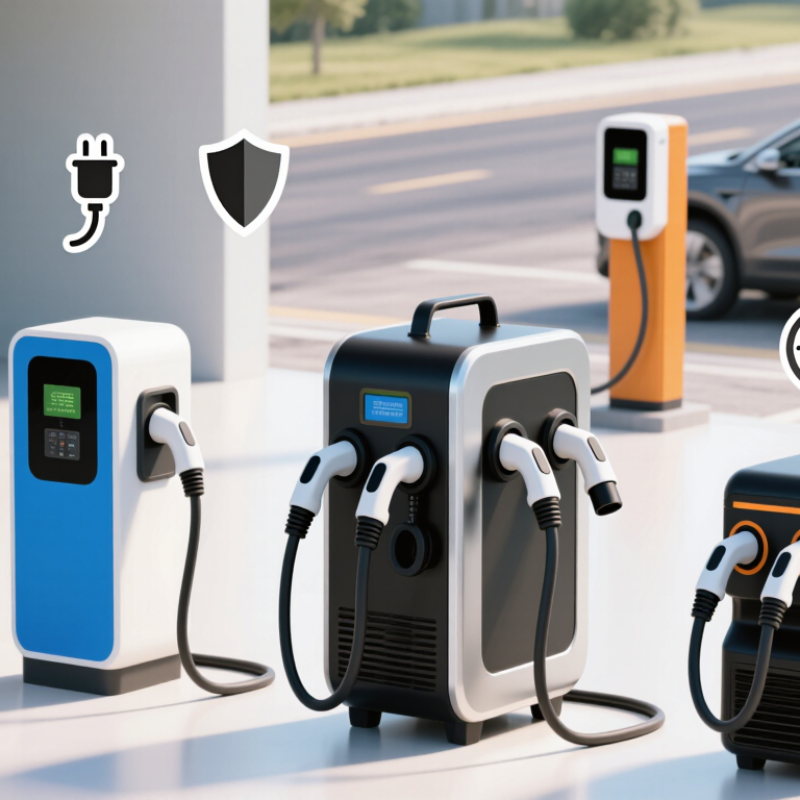
A portable EV charging station is equipment that lets an electric vehicle charge where a fixed charger is unavailable. Most portable units are compact electric vehicle supply equipment, or EVSE. They connect the vehicle to a suitable power source and manage the electrical connection. The vehicle’s onboard charger then converts incoming AC power for its battery. Some larger portable stations include a battery and supply stored energy instead. The label can be confusing. A portable EVSE does not create electricity; it needs a compatible outlet or another power source.
In practical use, a driver might keep a portable unit in the trunk for overnight charging at a rental home or campsite. Charging speed depends on the power source, the unit’s rated output, and the vehicle. It is often slower than using a dedicated high-power charger. Check connector compatibility and the vehicle manual before connecting. The outlet and circuit must also support the unit’s current. A warm plug, damaged cable, or loose connection deserves attention, not a quick workaround. Portable does not mean suitable for every outlet or weather condition. Details matter. Even experienced drivers can overlook them.
| Product Type | What It Is | Typical Power or Capacity | Power Supply | Typical Use | Key Considerations |
|---|---|---|---|---|---|
| Portable AC EVSE | A movable charging cable-and-control unit that supplies AC power to an EV. The vehicle’s onboard charger converts that AC power to DC for the battery. | Common configurations range from about 2.3 kW at 230 V/10 A to 7.4 kW at 230 V/32 A. Three-phase 400 V/16 A units can provide about 11 kW. | A compatible, properly rated outlet or other AC supply; it does not usually contain an energy-storage battery. | Home, workplace, or travel charging where a suitable power outlet is available. | Check the supply circuit, plug type, current setting, protective functions, and vehicle connector. Charging power may be limited by the outlet or the vehicle’s onboard charger. |
| Portable DC charger | A relocatable DC charging unit that supplies DC power directly to the vehicle battery through its charging system. | Equipment varies widely; mobile units are often designed in the tens-of-kilowatts range. Actual output depends on the unit, supply, and vehicle. | Typically requires a suitably rated electrical supply. Higher-power models may need dedicated site infrastructure and are not equivalent to a household plug-in charger. | Temporary charging sites, service operations, and locations where a fixed charger is unavailable. | Confirm input requirements, connector compatibility, vehicle charging limits, installation conditions, and applicable electrical standards. |
| Battery-buffered mobile charger | A mobile charging system with an internal battery that stores energy and later delivers it to an EV. Some designs also recharge from the grid between uses. | Battery energy and charging output are product-specific; these are not standardized ratings and should be checked against the product specification. | Internal battery, with grid or other charging input depending on the design. | Events, roadside support, depots, and temporary locations with limited grid capacity. | Compare usable energy, recharge time, DC or AC output, transport requirements, and the number of vehicle sessions available between recharges. |
| Portable EVSE vs. portable power station | A portable EVSE controls and protects the connection to an EV; a portable power station stores electricity. A power station can charge an EV only if its output, connector, and charging interface are suitable. | Power-station capacity is generally stated in watt-hours or kilowatt-hours; EVSE output is generally stated in kilowatts. | EVSE needs a compatible power source. A power station supplies stored energy within its rated output limits. | Choosing the right equipment for travel, backup use, or off-grid applications. | Do not assume that a household battery generator can directly charge every EV. Verify continuous output, grounding and protection, connector compatibility, and the vehicle’s minimum charging requirements. |
| Connector and standards check | Charging interfaces and requirements vary by market and charging mode. | Not a power rating. | Depends on the product and installation. | Product selection, importing, and use across different regions. | For China, check the applicable GB/T connector and safety requirements. Other markets may use different connector systems. Relevant standards include IEC 61851-1 for EV conductive charging systems and IEC 62752 for in-cable control and protection devices used in Mode 2 charging. |
Note: “Portable EV charging station” is a broad market term. Many portable units are EVSE devices that rely on an external AC supply; they do not store electricity. Charging speed depends on the available supply, EVSE rating, vehicle limits, battery condition, and other factors.