
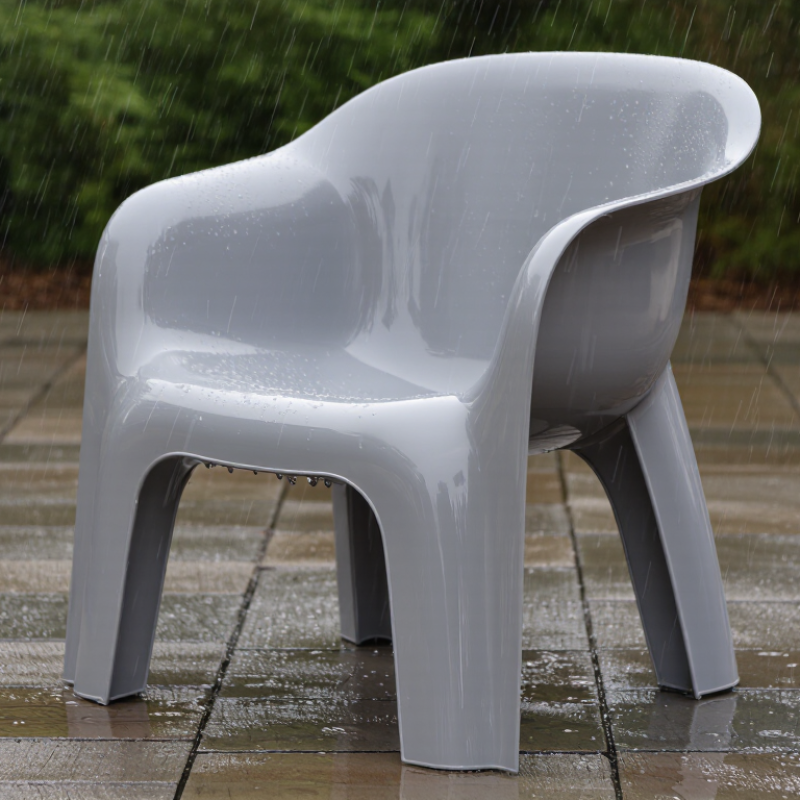
A Rotomolding Chair is made through rotational molding, a process that shapes heated plastic inside a slowly turning mold. The result is often a hollow, one-piece seat with rounded edges and no visible seams. Picture a chair pulled from a garden after rain: water slides from its smooth surface, while its broad legs keep it steady on a patio. Designs vary, so weight capacity, comfort, and weather resistance should be checked against the maker’s specifications.
Rotational-molding educator Glenn Beall is widely associated with practical guidance on the process. A responsible summary of his technical perspective is: “Good rotational molding depends on matching the material, mold, and process to the product.” This is a paraphrase, not a verified verbatim quotation. That distinction matters. A chair’s performance depends on more than its molded shape; wall thickness, resin choice, and quality control also affect durability. A thick-looking shell is not proof of strength.
This guide explores how a Rotomolding Chair is produced, what features to inspect, and where this seating works best. It also considers limitations, including possible flex, surface wear, and less cushioning than upholstered chairs. Some details are easy to overlook. I would not judge a chair by appearance alone: sit in it, check its stability on the floor, and review care instructions before choosing one.
What Is a Rotomolding Chair?
Definition and Core Structure of a Rotomolding Chair
A rotomolding chair is made by heating plastic powder inside a closed mold while the mold rotates on two axes. The softened material spreads along the mold’s inner surface, forming a hollow chair shell as it cools. The result is often a single molded seat and back, rather than several flat pieces joined together. Small differences in wall thickness can occur, so “one-piece” does not always mean perfectly uniform.
The shell provides the main sitting surface and transfers a user’s weight toward the chair’s base. Designers may add molded ribs underneath the seat or behind the backrest to improve stiffness. These ribs are not just decoration. Look beneath the seat: their shape and placement can reveal how the shell is supported. A simple shell may attach to separate legs or a frame through molded mounting points. In other designs, parts of the base are formed with the shell itself.
Details matter. Check the junctions.
A chair’s openings, edges, and attachment points also belong to its core structure. Rounded edges help avoid sharp contact points, while correctly fitted fasteners keep separate supports secure. The inside is generally hollow, which can reduce weight without requiring a solid block of plastic. Still, the exact construction varies by design. A molded chair may feel sturdy at first touch, but a close look at its underside often tells a more useful story.
Core Structure of a Representative Four-Legged Chair
A rotomolding chair is made by heating plastic powder in a rotating mold. Its seat and backrest are often formed as a hollow, continuous shell, while the base may include four legs. Counts shown are for a representative design; chair construction varies.
What Is a Rotomolding Chair?
A rotomolding chair is made by shaping plastic inside a hollow mold. The process begins with a measured amount of polymer powder placed in the mold. The closed mold is heated and turned slowly along two axes. As the material softens, it spreads over the interior walls. No high-pressure injection is needed. The result can be a hollow chair shell with broad curves and few joints.
Then it cools. The mold keeps rotating during this stage, helping the material set across the surface. Once cool, the shell is removed and checked for uneven areas, thin spots, or rough edges. Openings and mounting points may be formed in the mold or finished afterward, depending on the design. Details matter: a seat that looks smooth still needs consistent support beneath it.
Rotational molding allows rounded forms, but it also brings design limits. Thick sections may cool more slowly, while sharp corners can be difficult to shape evenly. A slight variation in surface or wall thickness can happen, so inspection is important. It is a practical method, not magic. The chair’s comfort still depends on its proportions, edge shape, and how steadily its legs meet the floor.
A rotomolding chair is formed by heating plastic powder inside a rotating mold. The powder melts and coats the mold’s inner surface, creating a hollow, one-piece shell. Polyethylene is common because it resists moisture, handles everyday impacts, and can be molded into broad, curved forms. Some designs use additives to improve outdoor performance, though sun exposure can still affect color over time.
The material shapes the chair’s feel as much as its appearance. A slightly flexible seat may feel less rigid, while thicker sections can add support and weight. Designers often use rounded edges, continuous contours, and integrated arms to avoid seams and make surfaces easier to wipe clean. Subtle ribs beneath the seat can help reinforce the shell without adding separate parts. Small details matter. Drainage openings may help outdoor chairs shed rain, but their placement can affect comfort and appearance. Still, I would not call every molded chair comfortable: a smooth shell can feel hard during long sitting, and fit depends on seat depth, back angle, and the user. A quick sit test tells more than a photograph.
A rotomolding chair is made by heating plastic powder inside a rotating mold. The softened plastic coats the mold’s interior and forms a hollow, generally seamless shell when cooled.
| Category | Common option or feature | What it means for the chair |
|---|---|---|
| Primary material | Polyethylene, commonly linear low-density polyethylene (LLDPE) | A widely used rotomolding plastic; its impact resistance and flexibility make it suitable for hollow furniture shells. |
| Other material options | Other polyethylene grades; occasionally other moldable polymers selected for a specific application | The chosen resin affects stiffness, impact performance, appearance, and suitability for indoor or outdoor use. |
| UV protection | UV stabilizers may be added to the plastic compound | Can help reduce sun-related fading and material degradation; outdoor durability depends on the formulation and exposure conditions. |
| Color and finish | Color is often mixed into the resin before molding; surfaces may be matte, textured, or smooth | Molded-in color avoids relying solely on a surface coating, while texture and finish are influenced by the mold and material. |
| Shell construction | Hollow, molded shell with no assembly seam across the main body | The one-piece form can reduce the number of joints in the shell. Legs, inserts, or other components may still be attached separately. |
| Wall thickness and strength | Wall thickness is designed for the chair’s geometry and intended loads | Ribs, curves, and reinforced areas can add stiffness; thickness can vary across the part, so design and testing matter. |
| Design geometry | Rounded transitions, drafted walls, and broad molded surfaces | These shapes help the part release from the mold and can create a distinctive sculpted seat and back. |
| Practical details | Drainage openings, feet, or mounting points may be incorporated into the design | Features vary by model and use; drainage openings can help prevent water from collecting on outdoor seating. |
| Storage and handling | Some designs are stackable or shaped for nesting | Stacking depends on the chair’s shape and clearances; it is not a feature of every rotomolded chair. |
| Typical design trade-off | Durable molded form versus weight, bulk, and production cycle time | Rotomolding supports large, complex hollow shapes, but part dimensions, material use, and manufacturing time influence cost and handling. |
A rotomolding chair is made through rotational molding, a process that forms plastic inside a heated mold. The result is usually a hollow, one-piece shell with few seams. This construction suits kitchens, patios, classrooms, cafés, and other busy spaces. In daily use, the chair feels practical rather than delicate. It can handle frequent movement, occasional knocks, and simple outdoor exposure. Smooth surfaces also make spilled drinks easy to wipe away.
Tips: Check the chair’s load rating before purchase. Look for stable legs and balanced support. Test the seat for ten minutes. That reveals pressure points quickly. Choose a light color for hot, sunny areas, because dark plastic can become uncomfortable. Keep drainage and ventilation in mind when chairs remain outside. These small details often matter more than appearance.
Rotomolding chairs have limitations. Their molded shape may provide only basic ergonomic support. A firm seat can feel tiring during long meetings or meals. Plastic may also become brittle after years of strong sunlight, depending on its formulation and maintenance. I would not assume every molded chair is equally weatherproof. Product specifications and real-use conditions matter. Some designs stack well, while others waste storage space. Repairs can be difficult if the shell cracks, since the one-piece structure is not always easy to restore. Durability is valuable, but it does not automatically mean comfort.
A rotomolding chair is formed by heating plastic powder inside a rotating mold. The process creates a strong, seamless shell with no visible joints. Its rounded edges help reduce snagging and make cleaning easier. These chairs are often chosen for patios, cafés, schools, waiting areas, pool decks, and temporary event spaces. They work well where furniture faces moisture, frequent movement, or careless stacking.
Outdoor use needs practical attention. Place chairs on level surfaces to reduce stress on the legs. Keep them away from direct contact with grills, heaters, and other hot equipment. Strong sunlight may slowly fade some plastics, even when the material is designed for outdoor use. Shade helps. A small oversight here can shorten the chair’s useful appearance.
Clean the surface with warm water, mild soap, and a soft cloth. Remove sand and food particles before wiping, because grit can create fine scratches. Avoid abrasive powders, steel brushes, and harsh solvents. Let trapped water drain from hollow areas after washing. Inspect the seat, legs, and underside regularly for cracks or sharp damage. Do not use a damaged chair in public areas. Care instructions can vary by plastic type, so the supplier’s technical guidance should take priority. Not every rotomolding chair performs equally in cold weather, either; brittle plastic is a risk worth checking before seasonal storage.
880 W 9th Street
Upland, California 91786
884 W 9th Street
Upland, California 91786
886 W 9th Street
Upland, California 91786
884 W 9th Street
Upland, California 91786