What Is an EV Charger Tester?
An electric vehicle charger may look simple from the outside: a cable, a connector, and a status light. Inside, however, safe operation depends on electrical protection, communication signals, and correct power delivery. An Ev Charger Tester helps technicians assess these functions before a charging point is trusted for everyday use. It can check items such as protective-earth continuity, pilot signals, and residual-current protection, depending on the tester and test procedure. It does not replace qualified installation or every required inspection.
The need for dependable checks is growing. The International Energy Agency’s Global EV Outlook 2024 reports that public charging points exceeded four million worldwide in 2023, rising by about 40% in one year. More charging equipment means more commissioning, troubleshooting, and maintenance work. A bright green indicator is not enough. A technician may also need to verify signal behavior, confirm protective measures, and record results with suitable equipment.
IEA Executive Director Fatih Birol has emphasized that charging infrastructure must expand alongside electric-car adoption. That broader industry message matters to testing: reliable access depends on chargers that work safely in real conditions. A tester gives technicians a way to examine electrical and communication behavior, rather than relying only on a screen or a driver’s report. Still, one test cannot prove everything. Results depend on the tester’s capabilities, correct setup, and the charger’s design. The practical question is not merely whether power flows, but whether the charger responds as intended.
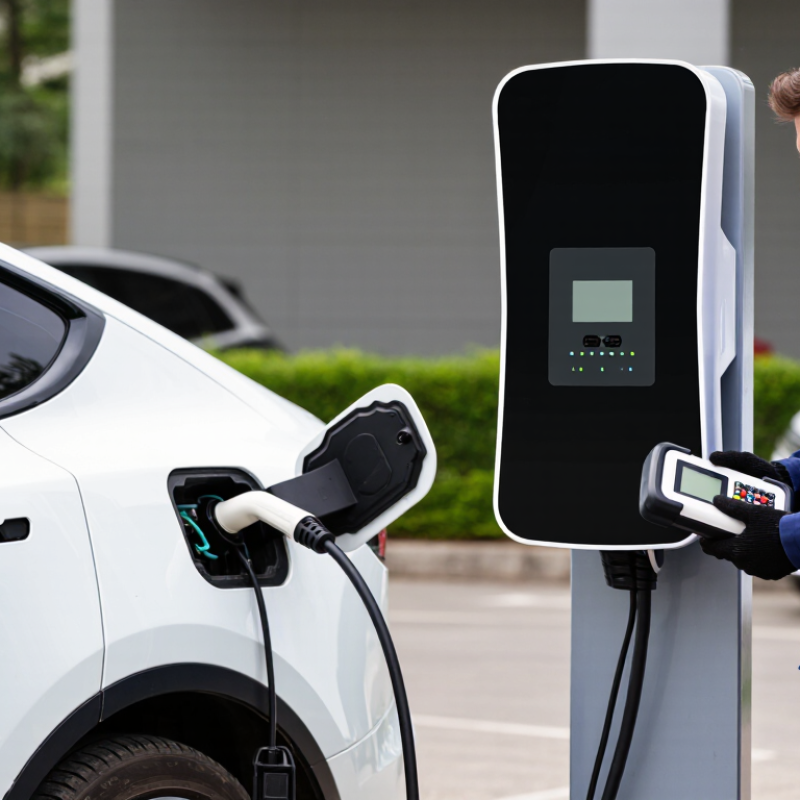
Definition and Purpose of an EV Charger Tester
An EV charger tester is a diagnostic instrument used to check an electric vehicle supply equipment (EVSE) outlet or charging cable. It connects to the charging point and simulates an electric vehicle’s electrical signals. This lets a technician check whether the charger recognizes a connection and responds correctly before a vehicle is plugged in. Small signals matter.
Depending on its design, a tester can check control-pilot and proximity-pilot behavior, protective-earth continuity, voltage, and selected safety-device functions. These checks help identify faults such as a missing earth connection or an incorrect charging state. Many test procedures refer to IEC 61851, the international standard series for conductive EV charging systems. The International Energy Agency’s Global EV Outlook 2024 reported that public charging points worldwide grew by more than 40% in 2023, with fast chargers rising by about 55%. More equipment means more need for consistent inspection.
A tester does not prove that every real-world charging session will be trouble-free. It checks specific electrical conditions under controlled circumstances, and its capabilities vary by model. A qualified technician should interpret the readings and follow the equipment manufacturer’s instructions. A display showing “pass” is useful, but it is not the whole story. Physical damage, loose terminals, and installation issues may still need hands-on inspection.
Key Components and Measurements
What Is an EV Charger Tester?
Key Components and Measurements
An EV charger tester uses a connector adapter to link safely with a charging point. Its control-pilot circuit simulates vehicle communication, while proximity detection checks whether the plug is seated and the cable is present.
Small details matter. A loose connection can distort a reading or interrupt a test.
The instrument may measure voltage and frequency, then display the control-pilot signal and its duty cycle. Some models check protective-earth continuity and test residual-current protection. Measuring actual charging current may require a suitable load or separate equipment; a tester alone cannot always confirm performance under load. Technicians should compare readings with the charger’s specifications and use properly rated, calibrated instruments.
I’ve seen a normal-looking voltage reading treated as proof that everything works. It isn’t. Results depend on test conditions, instrument limits, and the charger’s operating state. Calibration slips, adapter wear, and inconsistent contact can all matter. For unfamiliar equipment, pause and verify the procedure rather than trusting a single display.
How an EV Charger Tester Works
What Is an EV Charger Tester?
How an EV Charger Tester Works
An EV charger tester checks whether a charging point can communicate with a vehicle and deliver power as expected. The exact functions vary by model. Some testers check basic wiring and voltage, while advanced units can simulate a connected vehicle.
The process begins when a technician connects the tester to the charger. Its display may show voltage, grounding status, and the state of the control pilot signal. That signal helps the charger recognize a vehicle and determine whether charging can begin. The tester can imitate different vehicle states, such as connected but not ready, or ready to charge. The charger should respond by changing its signals and, where appropriate, enabling power. The sequence matters.
Some units also measure current under load or record faults for later review. A technician compares these readings with the charger’s specifications and checks for unexpected changes. Small details count. A poor connection or unsuitable test setup can produce confusing results, so the readings need context. A tester also has limits: it cannot reproduce every vehicle, cable, or site condition. Skilled inspection and repeat measurements may still be needed before a charger’s performance is understood.
Safety Standards and Testing Applications
An EV charger tester checks whether charging equipment behaves safely and communicates correctly with a vehicle. Its checks may include protective-earth continuity, insulation resistance, voltage, and residual-current protection. It can also simulate vehicle states to test the charger’s control-pilot response. Exact procedures depend on the equipment and the safety standards adopted in the relevant region. A tester does not make equipment compliant by itself; results need to be compared with applicable requirements and recorded by a qualified technician. Small details matter.
Testing is useful during commissioning, scheduled maintenance, and fault investigation. A technician might check a wall-mounted unit, inspect connector contacts for heat damage, then confirm that protective functions respond as expected. Some tests require isolation or specialized procedures, so the manufacturer’s instructions and site safety rules matter. A calibrated instrument and clear records make results more dependable. Still, one clean reading can be reassuring too quickly. Intermittent faults may appear only when a cable moves or a charger warms up. Testers also cannot judge every installation detail, such as poor strain relief or water entering a damaged enclosure. A careful visual inspection should accompany measurements, and unusual readings deserve follow-up rather than guesswork.