What Is an Injection Machine and How Does It Work?
An injection machine is more than a press that closes a mold. It is a coordinated system for melting material, injecting it under pressure, cooling it, and ejecting a finished part. Each cycle leaves clues: a short shot may point to insufficient filling, while a warped edge can signal uneven cooling. Understanding these details helps readers see why machine settings, mold design, and material choice must work together.
The market reflects the process’s broad industrial use. Grand View Research estimated the global injection molding machine market at approximately US$10.5 billion in 2023; its market figures are estimates, not production counts. For a technical perspective, polymer-processing professor and author Dr. Tim A. Osswald is a useful reference. His work emphasizes how material behavior and processing conditions shape product quality. A concise paraphrase of that principle is: “Material, mold, and process must be considered together.” This is a paraphrase, not a verbatim quotation.
This guide explains the machine’s main components and traces a typical molding cycle, from pellet feeding to part release. It also distinguishes clamping force, injection pressure, and cycle time—terms that are often confused. Small differences matter. A few degrees or seconds can change how plastic fills a cavity and cools. The overview is not a substitute for machine-specific manuals or trained operators. Real production is less tidy than a diagram, and process tuning still requires careful observation.
What an Injection Machine Is and What It Produces
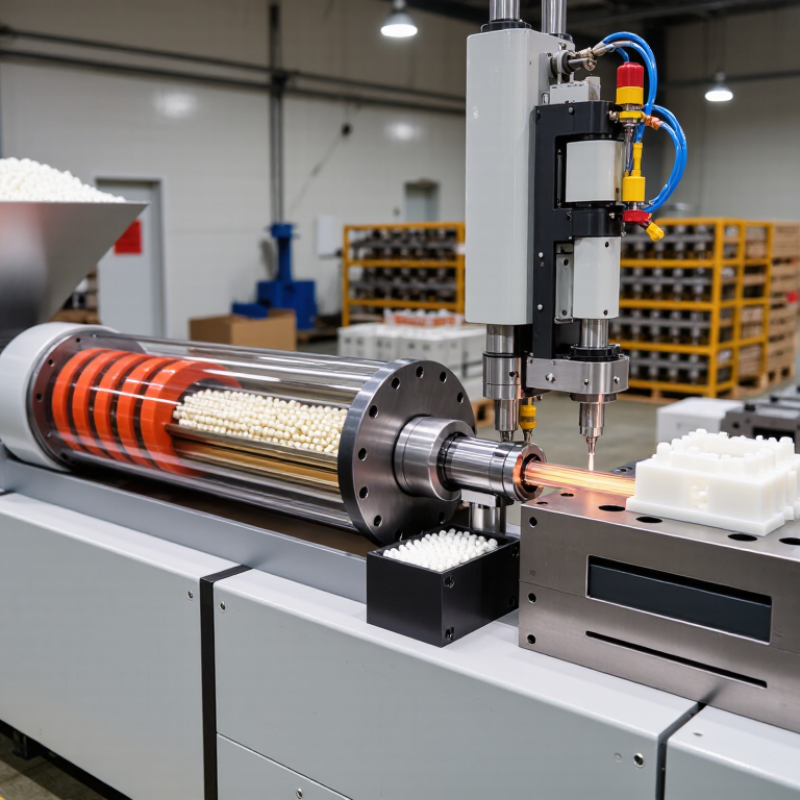
An injection machine, often called an injection molding machine, turns plastic material into shaped parts. Pellets fall from a hopper into a heated barrel. A rotating screw moves them forward, mixing and melting the material. Then it pushes the melt through a nozzle and into a closed mold. The clamping unit keeps the mold shut under pressure while the part cools. Once firm, the part is released by ejector pins. The machine controls the cycle; the mold gives the product its shape and surface details.
The products can include storage containers, appliance housings, bottle caps, chair components, and small clips. Part size, texture, and precision depend on the mold, material, and process settings. A tiny gate mark or seam may remain where the material entered or where mold sections met. These traces are often expected, but they can affect appearance or fit. In practice, the process is less tidy than a diagram suggests. Defects happen. Warping, short fills, or uneven surfaces can result from poor settings, material changes, or worn equipment, so operators inspect parts and adjust conditions during production.
How Plastic Is Fed, Heated, and Melted
Plastic pellets usually enter an injection machine through a hopper mounted above the barrel. Gravity guides them into a rotating screw, which carries the material forward. The feed throat is kept cool enough to stop pellets softening too early. Small details matter. Damp or contaminated pellets can cause bubbles, weak parts, or inconsistent flow. Material handling should match the resin’s specific requirements.
Along the barrel, heater bands raise the temperature in controlled zones. The screw does more than push pellets. Its rotation compresses and shears them, adding frictional heat as the plastic moves toward the nozzle. Gradually, solid granules become a uniform melt. This transition takes time. Operators monitor temperature, screw speed, and back pressure because excess heat or long residence time can degrade some plastics.
A properly melted shot should be consistent, but real production is less tidy than a diagram. Color streaks, unmelted specks, or changing shot weight may point to moisture, uneven feeding, or settings that need review. Not every symptom has one cause. Checking the material, barrel zones, and screw recovery together is more reliable than changing temperatures at random. Careful preparation helps the machine fill the mold evenly when injection begins.
What Is an Injection Machine and How Does It Work?
Typical melt-processing temperature ranges for common plastics (°C)
Plastic pellets are fed from a hopper into a heated barrel. A rotating screw moves and compresses them while barrel heat and friction soften and melt the plastic. The temperature ranges shown are approximate; the correct setting depends on the material grade and machine.
How the Injection Molding Cycle Works
What Is an Injection Machine and How Does It Work?
How the Injection Molding Cycle Works
An injection molding cycle begins when two mold halves close and clamp together. Inside the heated barrel, a rotating screw melts plastic pellets and moves the material toward the nozzle. The screw then pushes the melt into the mold cavity under controlled pressure. Think of filling a narrow space quickly, without trapping too much air. Once the cavity is full, holding pressure helps compensate for shrinkage as the plastic cools. That pause matters.
Cooling takes place inside the closed mold, often while the next batch of pellets is being prepared. When the part is firm enough, the mold opens and ejector pins release it onto a tray. The machine then closes the mold again. The cycle repeats, but not always identically: material moisture, mold temperature, and part thickness can shift cooling time or cause defects. A technician may inspect the part, adjust settings, and check the next cycle rather than trusting one successful shot. A small change can matter. The cycle is straightforward in outline, yet steady results depend on monitoring each stage.
Common Machine Types and Their Uses
An injection machine melts material, pushes it into a closed mold, and holds pressure while the part cools. A screw inside the heated barrel usually mixes and advances plastic pellets. The clamp keeps the mold halves firmly together. Small details matter.
Hydraulic machines use fluid pressure to move the screw and clamp. They suit demanding jobs that need strong clamping force, though they may use more energy. Electric machines control movement with motors, often offering precise, repeatable cycles for small parts or tight tolerances. Hybrid machines combine both approaches. Vertical machines are useful when inserts must be placed into a mold before injection; horizontal machines handle many general-purpose production runs. These machines make items such as caps, housings, connectors, and appliance components. No type is best for every job. Part size, material, mold design, and production volume all affect the choice.
Tips: Match the machine’s clamping force and shot capacity to the mold and part. Check material drying needs, too. A cycle that looks stable can still hide uneven filling, so inspect sample parts for short shots, flash, and inconsistent dimensions before increasing production.
What Is an Injection Machine and How Does It Work? — Common Machine Types and Their Uses
An injection molding machine melts plastic resin, injects it into a closed mold, holds pressure while the part cools, and then opens the mold so the finished part can be ejected. The machine’s clamping, injection, and control systems work together to repeat this cycle.
| Machine type or configuration |
How it works |
Common uses |
Typical strengths and considerations |
| Hydraulic |
Hydraulic pumps and cylinders provide the force for clamping and injection. The screw inside the heated barrel melts and meters resin before pushing it into the mold. |
Large molded parts, general-purpose production, and applications requiring substantial clamping force. |
Robust and versatile; hydraulic systems require fluid and temperature management and may use more energy at idle than fully electric systems. |
| All-electric |
Electric servo motors drive machine movements such as injection, clamping, and screw rotation, with movements controlled independently. |
Precision parts, medical components, electronics, and clean production environments. |
Often offers precise repeatability and lower energy use during many operating conditions; suitability depends on required force, part size, and process needs. |
| Hybrid |
Combines electric drives for selected movements with hydraulic power for other functions, depending on the machine design. |
Production that needs a balance of high output, process control, and substantial clamping or injection force. |
Can combine advantages of electric and hydraulic systems; energy use and maintenance requirements vary with the design and operating cycle. |
| Vertical |
The mold closes vertically. Many configurations allow an operator or robot to place an insert into the open mold before injection. |
Insert molding, overmolding, and parts that combine plastic with metal or other components. |
Gravity can help keep inserts in position; manual insert loading may affect cycle time unless automated. |
| Two-platen |
The clamping unit uses two main platens and a compact mechanism to open and close the mold and generate clamping force. |
Large molds and applications where a compact machine layout is useful. |
Can provide a shorter overall machine footprint for high-clamp-force applications; mold access and tie-bar spacing should be checked against tooling needs. |
| Multi-component |
Uses two or more injection units to inject different materials or colors into one mold, either together or in sequence. |
Two-color parts, soft-touch grips, seals bonded to rigid components, and other multi-material products. |
Can produce integrated parts in one cycle; requires compatible materials, suitable mold design, and coordinated injection control. |
Note: These categories can overlap. For example, a machine may be both vertical and all-electric, or use a two-platen clamp with a hybrid drive system.